
Wexford County Circuit Court Overview
In Michigan, the circuit court is the trial court of broad jurisdiction. It hears felony criminal cases, civil suits where the amount in dispute is more than $25,000, and family matters through its family division. It also hears appeals that come up from lower trial courts and from state administrative agencies. Wexford County is served by the 28th Circuit Court, a court shared with neighboring Missaukee County.
Because the 28th Circuit covers two counties, it is what Michigan calls a multi-county circuit. Court sessions are held in Cadillac for Wexford County cases and in Lake City for Missaukee County cases. The state's trial court structure places circuit, district, and probate courts side by side, each with its own role, so a single dispute can touch more than one of them before it ends.
Trial Courts Serving Wexford County
Four court offices handle the bulk of local case work, and all of them share the county building in downtown Cadillac. The circuit court and its family division take the most serious and the most sensitive cases. The district court is the busy front door for smaller and faster matters. The probate court keeps its own docket for estates and protective cases. The table below lists each court, what it handles, where it sits, and how to reach it.
| Court | Type / Jurisdiction | Address | Phone |
|---|---|---|---|
| 28th Circuit Court | Felonies, civil over $25,000, appeals | 437 E. Division St., Cadillac, MI 49601 | (231) 779-9490 |
| 84th District Court | Misdemeanors, felony first stages, civil under $25,000, small claims, landlord-tenant, traffic | 437 E. Division St., Cadillac, MI 49601 | (231) 779-9515 |
| Wexford County Probate Court | Estates, trusts, guardianships, conservatorships, mental health | 437 East Division Street, Cadillac, MI 49601 | (231) 779-9510 |
| 28th Circuit Family Division | Divorce, custody, paternity, support, juvenile, adoption, name change, family PPO | 437 E. Division St., Cadillac, MI 49601 | (231) 779-9490 |
Circuit Court vs District Court vs Probate Court
These three trial courts split the work by case size and case type, not by neighborhood. The circuit court takes the big claims and the felonies. The district court takes the smaller claims and the misdemeanors, and it also runs the early stages of every felony. The probate court handles estates and the care of people who cannot manage their own affairs. The comparison below lines up the main differences.
| Circuit Court | District Court | Probate Court | |
|---|---|---|---|
| Jurisdiction | Broad, general | Limited | Specialized |
| Civil dollar limit | Over $25,000 | Up to $25,000 | Set by estate or trust value, not a claim limit |
| Criminal cases | Felonies after bindover | Misdemeanors and felony first stages | None |
| Other case types | Divorce, custody, juvenile (family division), appeals | Small claims, landlord-tenant, traffic | Guardianship, conservatorship, mental health |
| Where sessions held | Cadillac and Lake City | Cadillac | Cadillac |
How a Case Moves Through the Court System
Most cases start at a lower court and can climb through the system on appeal. A civil suit or a felony begins in a trial court, moves to a higher court if a party appeals, and can end at the top of the state judiciary. The general path runs from the trial courts up through the appellate courts, and each step has its own rules and deadlines.
General appeal path: 84th District Court › 28th Circuit Court › Michigan Court of Appeals › Michigan Supreme Court
Felony cases follow a special route because they touch both trial courts. A felony charge is read first in the district court, tested at a probable cause conference and a preliminary examination, and then sent up to the circuit court through a step called bindover. Once the case is bound over, the circuit court handles the plea, the trial, and the sentence.
Felony bindover path: Arrest › District Court arraignment › Probable cause conference › Preliminary examination › Bindover to Circuit Court › Circuit arraignment › Pretrial › Trial › Sentencing › Appeal
Cases the Wexford County Circuit Court Hears
The circuit court is where a felony ends up after the district court finds probable cause. At that stage the court manages pleas, motions, trial settings, sentencing, and probation terms, and it enters the judgment of sentence. On the civil side, the court hears money disputes above the district court limit, along with appeals from lower trial courts and state agencies. Divorce, custody, and other family cases run through the court's family division. Case files, pleadings, and payments for circuit matters go through the county clerk counter that serves as the circuit clerk.
A few terms come up often when people read a circuit file. The short list below explains the ones that cause the most confusion.
- Bindover
- The transfer of a felony from the district court to the circuit court after a judge finds probable cause.
- Disposition
- The current or final outcome of a charge or a case.
- Register of actions
- The running list of everything filed and every event in a case, and often what an online search shows.
- Motion
- A written request that asks the court to order something before or during a case.
Detailed case files, registers of action, and copies for circuit matters are part of the broader set of Wexford County court records, and they follow Michigan court rules for public access rather than the county's general records policy.
The 84th District Court in Wexford County
The 84th District Court is the limited jurisdiction court, and it carries a heavy daily load. It handles misdemeanors, civil cases up to $25,000, small claims, landlord-tenant disputes, and civil infractions. It also runs the first steps of every felony before the case is bound over to the circuit court. Judge Corey J. Wiggins presides, and an attorney magistrate handles arraignments, small claims, and informal hearings.
The court splits its work into divisions. The county describes its District Court Civil Division as the home for general civil suits, small claims, and summary proceedings such as landlord-tenant cases.
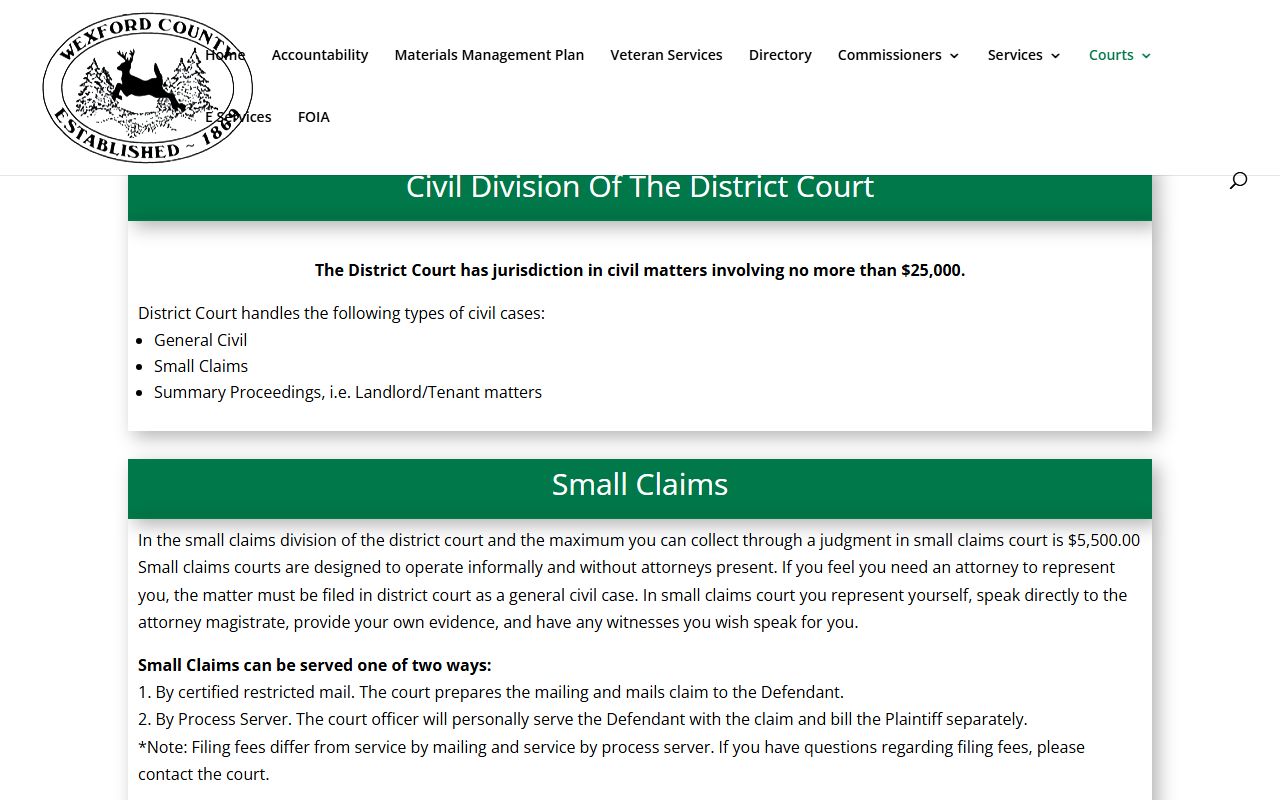
Small claims cases are informal, and the county notes that parties speak directly to the magistrate without attorneys present. The criminal side of the court moves on a fixed weekly rhythm, which the county lays out on its District Court Criminal Division page.
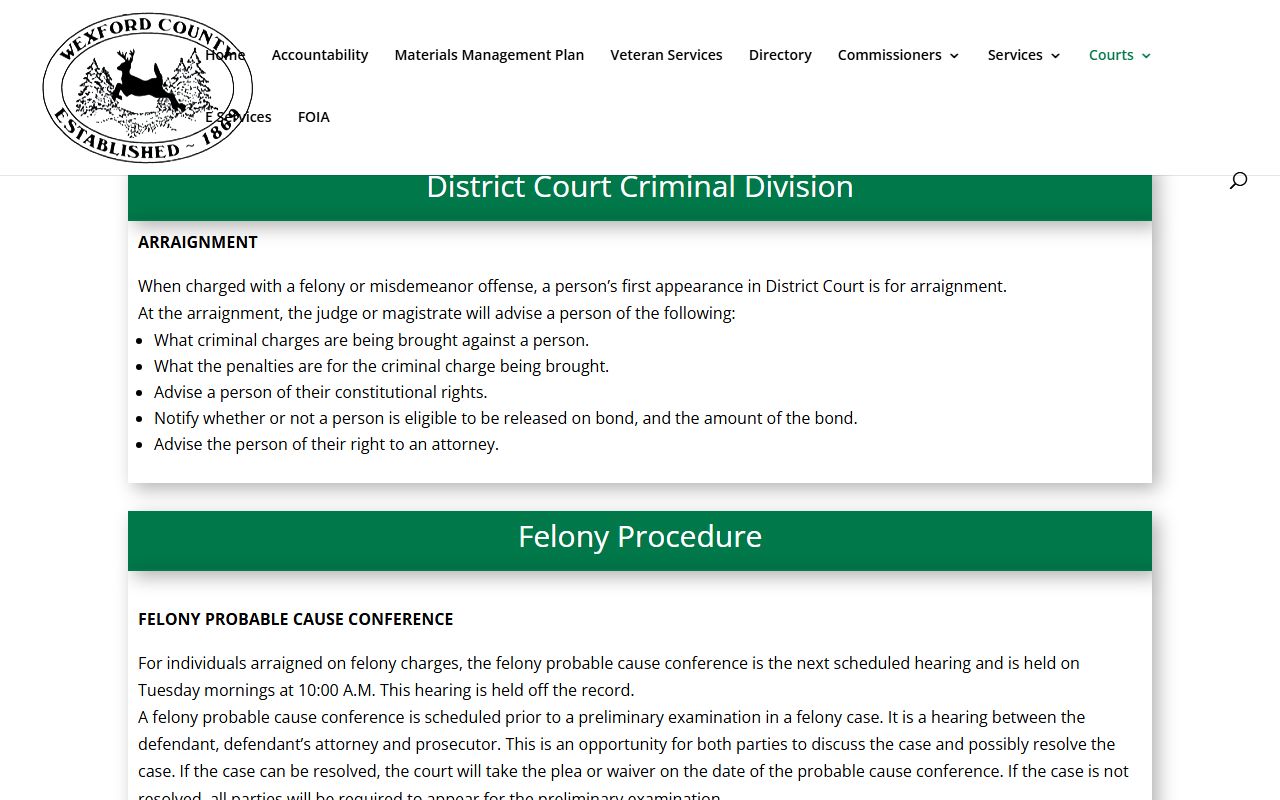
Arraignment is the first appearance for a misdemeanor or a felony, and the judge or magistrate reviews the charge, the penalties, constitutional rights, and bond. Felony probable cause conferences fall on Tuesday mornings and preliminary examinations on Tuesday afternoons, which helps people time a visit to the court.
Wexford County District Court Traffic Division
Traffic tickets and civil infractions run through the district court, not the circuit court. The county's District Court Traffic Division sets tight deadlines after a citation is issued, and it lays out the choices a driver has for paying or contesting a ticket.
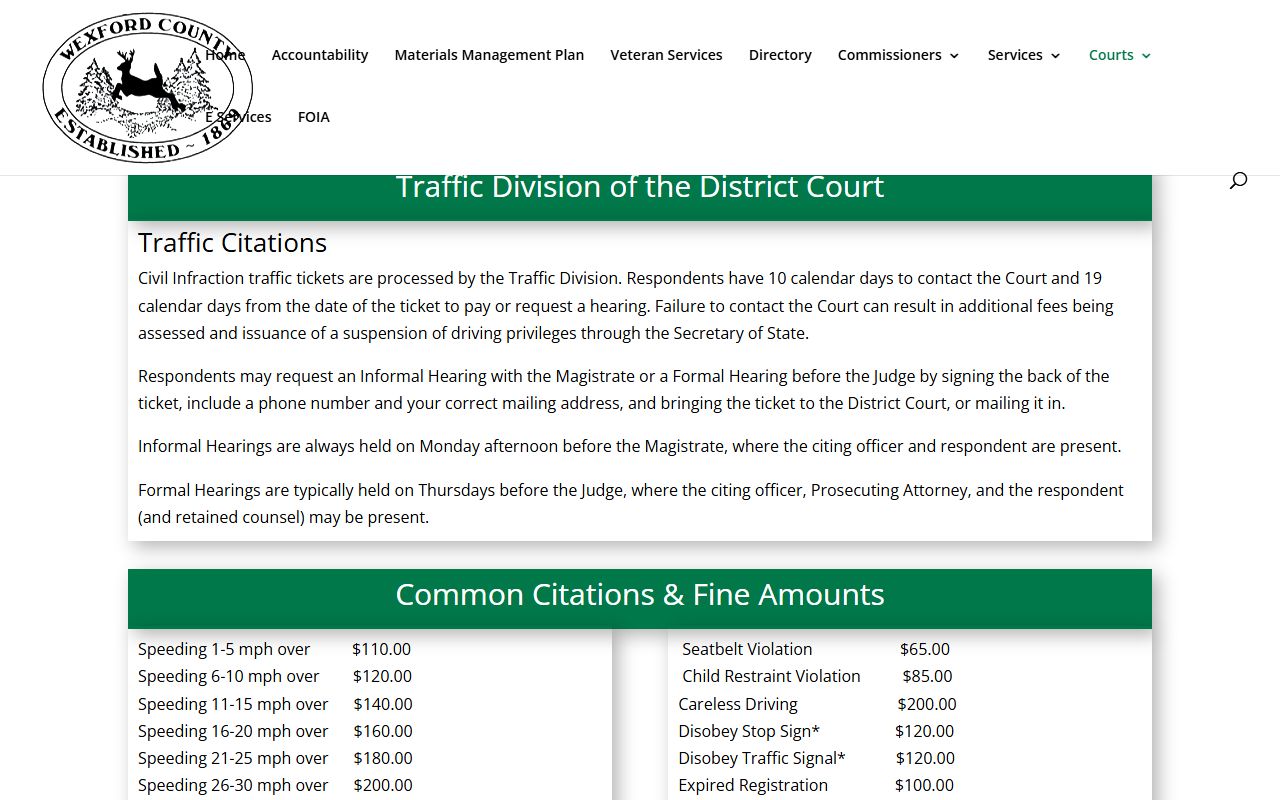
A person who gets a ticket has 10 days to contact the court and 19 days from the ticket date to pay or ask for a hearing. Informal hearings are held on Monday afternoons before the magistrate, and formal hearings usually fall on Thursdays before the judge. Points are added by the Secretary of State, and the court has no say over how many points a violation carries.
Note: A traffic ticket handled in the district court is a separate file from the driving record kept by the Michigan Secretary of State.
Family Division and Probate Court in Wexford County
Michigan created the Family Division of the circuit court in 1998 to gather family matters under one presiding judge. In Wexford County the family division handles divorce, custody, paternity, child support, parenting time, juvenile delinquency, child neglect and abuse, adoption, emancipation, name changes, and family personal protection orders. Many of these files are sensitive, and juvenile, adoption, and abuse matters are nonpublic. Divorce judgments and family case copies route through the circuit court and the county clerk.
The Wexford County Probate Court keeps its own docket for estates, trusts, guardianships, conservatorships, and involuntary mental health treatment. Judge Edward D. Van Alst serves as the probate judge and, following the northern Michigan pattern, also serves as presiding judge of the family division. The probate court holds sessions daily and sets aside each Thursday for the probate docket. Mental health and developmentally disabled guardianship files are restricted, so they are not open public lookups.
Jury Service for Wexford County Courts
One jury pool serves the 28th Circuit Court, the 84th District Court, and the probate court for Wexford County. The county's Jury Duty page lists upcoming trial dates and explains that service runs on a two-month term.
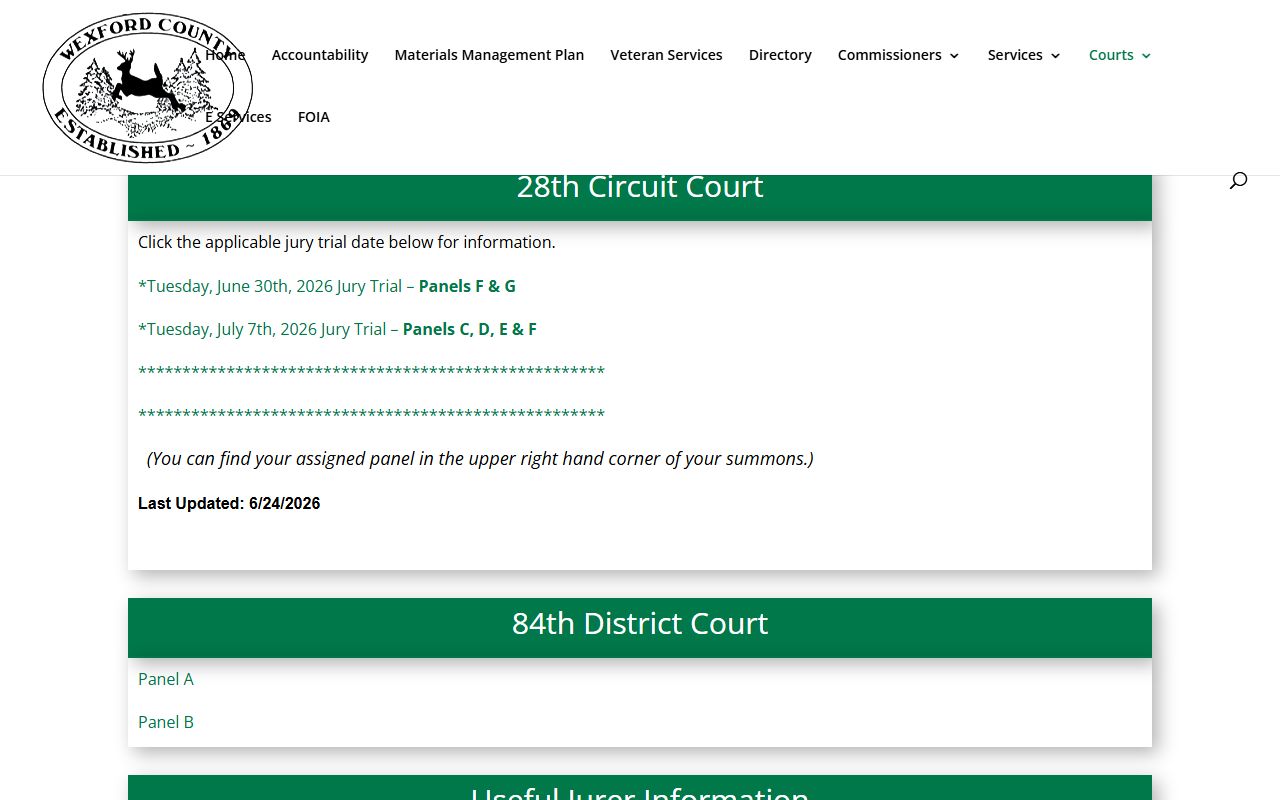
Jurors are drawn at random from Secretary of State records, and they must return a qualification questionnaire within 10 days. Wexford County uses a telephone call-in system so jurors can learn whether they are needed on a given day. Excusal requests must be in writing and cannot be made after 1:00 p.m. the day before trial.
Who may serve is set by state law. The Michigan juror qualifications statute, MCL 600.1307a, lists the basic requirements and exemptions the county follows.
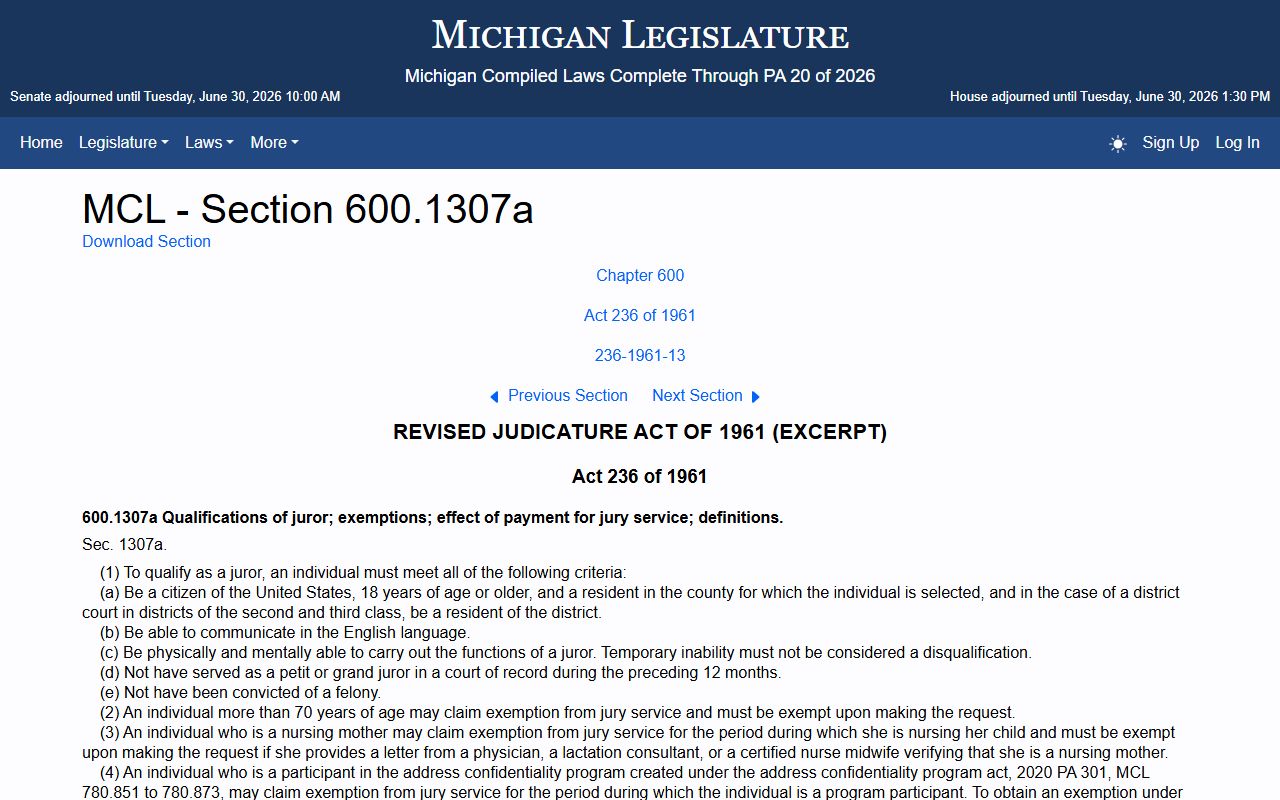
The statute sets out who is eligible to sit on a jury. The core points the court applies include the following.
- Be a United States citizen and at least 18 years old.
- Live in the county the court serves.
- Be able to speak and understand English.
- Have no felony conviction that bars service.
- Be physically and mentally able to serve.
Wexford County Circuit Court Judges and Sessions
Circuit judges are elected. Voters within the circuit choose them for six-year nonpartisan terms, and the seats are state-funded positions with salaries set by the Legislature. To run, a person must be a qualified elector, a resident of the judicial circuit, a lawyer licensed for at least five years, and under the age of 70. The current bench lists Hon. Jason J. Elmore as chief circuit judge and Hon. Edward D. Van Alst as presiding judge of the family division.
Because the 28th Circuit spans two counties, its judges travel between county seats. Wexford County sessions are held in Cadillac, while Missaukee County sessions are held in Lake City. Parties in the shared circuit should confirm which county seat their hearing is set for before they travel. The circuit court office keeps regular weekday hours and closes from noon to 1:00 p.m. for lunch, and the county clerk counter that serves as circuit clerk sits one floor below the courtroom. Hearing schedules for the local courts are posted as public Wexford County court dockets.
28th Circuit Court
437 E. Division Street
Cadillac, MI 49601
Phone: (231) 779-9490
Fax: (231) 306-2155
Email: circuitcourt@wexfordcounty.org
Monday to Friday, 8:30 a.m. to 5:00 p.m. (closed noon to 1:00 p.m.)