
Criminal Court Records in Wexford County
A criminal court record is the case file a court opens once a prosecutor files charges. It is not the same as an arrest report. The arrest is a police event, while the court record is the running account of what the court did with the case. Clerks keep the file, add each new document, and log every hearing on a register of actions. In Wexford County the file grows from the first appearance to the last order, and it stays part of the public record long after the case closes.
Two trial courts handle criminal matters here. The 84th District Court takes all misdemeanors and the early stages of felonies, including arraignment, the probable cause conference, and the preliminary examination. The 28th Circuit Court, which serves both Wexford and Missaukee counties, takes felony cases once a judge finds probable cause and binds the case over. District criminal files show arraignment, bond, pretrial, and bindover events. Circuit files pick up after bindover and add pleas, motions, trial settings, the judgment of sentence, probation terms, and any appeal.
The charges themselves, from the complaint through any amendment, are covered on the Wexford County arrest records and court charges page, while every other case type sits alongside criminal files in the county court records system.
How to Search Wexford County Criminal Court Records
Most searches begin online with MiCOURT Case Search, the statewide trial court system that Wexford County links from its own Record Search menu. MiCOURT can return criminal, civil, traffic, family, and probate cases for participating courts. A case number search finds any file containing the value entered, and a name search matches participants whose names begin with the letters typed. When a file is not online, or a certified copy is needed, the district or circuit clerk counter fills the gap.
- Open the MiCOURT Case Search portal and select a Wexford County court where the court field is offered.
- Search by the defendant name or, if you have it, by the case number.
- Narrow the results by court, case type code, and filing date to reach the right file.
- Open the case to read the register of actions, the charges, and the disposition.
- Ask the clerk of the convicting court for a certified copy when the record is needed for an official purpose.
For a statewide criminal history rather than a single case, the Michigan State Police runs the Internet Criminal History Access Tool, known as ICHAT. A search covers felony and serious misdemeanor convictions across Michigan for a set fee. ICHAT reflects convictions reported by courts and does not list open warrants, so it is a background check rather than a warrant lookup. The lead-in image below opens the official criminal history records page maintained by the state police.
The Michigan State Police Criminal History Records page explains how ICHAT works and what a report includes.
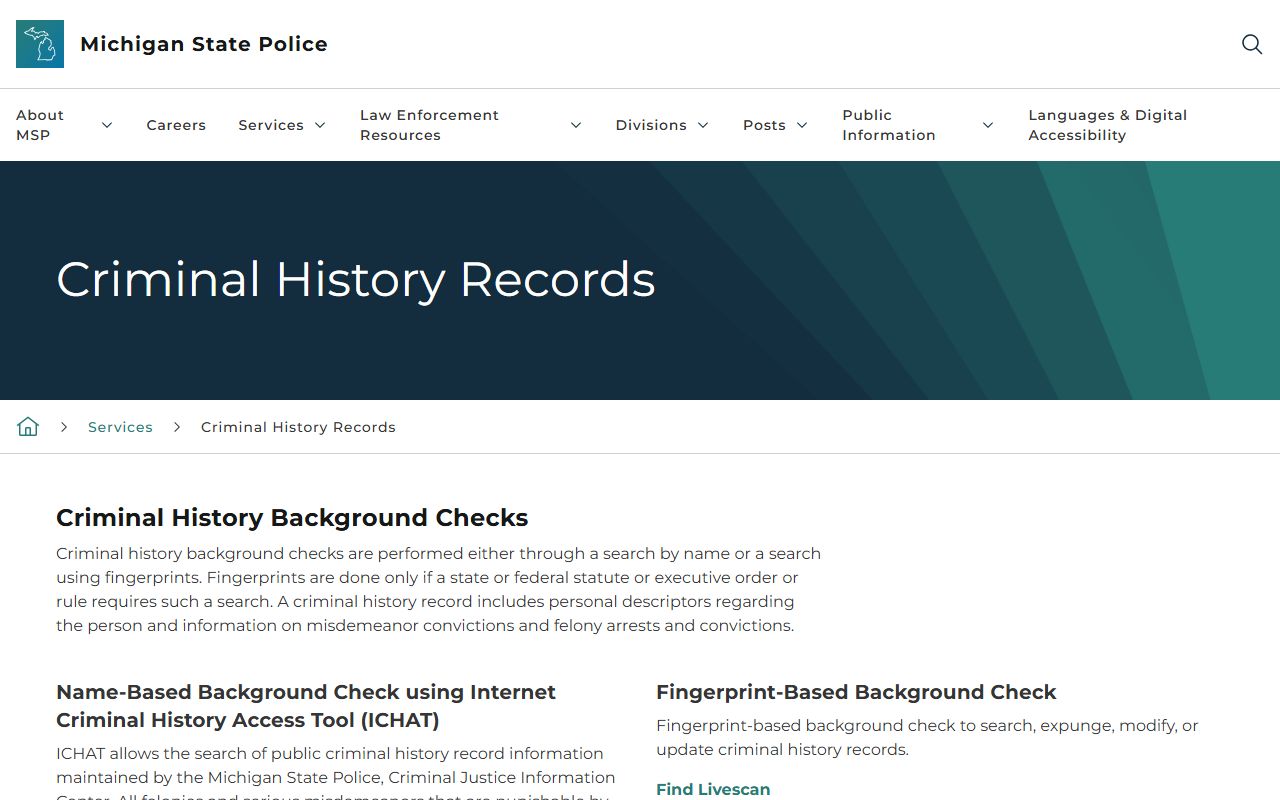
An ICHAT report complements a Wexford County criminal court records search by confirming statewide convictions that a single county file might miss.
Stages of a Wexford County Criminal Case
Every entry in a criminal court record maps to a stage of the case. Knowing the order helps you place a hearing code or a docket line. Misdemeanors run through the 84th District Court from start to finish. Felonies begin there too, then move to the 28th Circuit Court after bindover. The path is the same for most defendants, even when the timing shifts.
Case flow: Charges Filed › Arraignment › Probable Cause Conference / Preliminary Examination › Bindover › Plea or Trial › Disposition › Sentencing
Local scheduling gives several of these stages a fixed slot. Video arraignments are usually held at 1:30 p.m. each day. Felony probable cause conferences fall on Tuesday mornings at 10:00 a.m. and are held off the record. Preliminary examinations follow on Tuesday afternoons at 2:00 p.m. The table shows what happens at each major stage and where it lands in the file.
| Stage | What Happens |
|---|---|
| Arraignment | The first appearance. The judge or magistrate reads the charges and penalties, advises constitutional rights, sets bond eligibility and amount, and addresses the right to an attorney. |
| Probable Cause Conference | A felony conference before the preliminary exam where the prosecutor and defense discuss the case, plea offers, and whether the exam will be waived. |
| Preliminary Examination | A felony hearing where the prosecutor must show probable cause that a crime occurred and the defendant committed it. If met, the case binds over to Circuit Court. |
| Pretrial / Motions | Misdemeanor pretrial and final pretrial, or circuit motions, where the parties raise legal issues, exchange information, and try to resolve the case before trial. |
| Plea or Trial | The defendant pleads guilty or no contest, or the case goes to a jury or bench trial that ends in a verdict. |
| Sentencing | After a plea or guilty verdict, the court imposes the sentence and enters the judgment of sentence, which fixes jail or prison time, probation, fines, costs, and restitution. |
Note: A felony defendant who waives the preliminary examination moves straight to Circuit Court, so the exam line may be absent from the record.
Prosecutor and Public Defender in Wexford County
Two offices shape the criminal case file more than any other. The Wexford County Prosecuting Attorney decides what to charge and drives the case forward. The Wexford Missaukee Office of Public Defender supplies a defense attorney to eligible defendants who cannot afford one. Their filings, motions, and appearances all become part of the record.
Prosecuting Attorney Johanna Carey leads the charging office from the courthouse on East Division Street. The office reviews police reports, files the complaint, handles bond arguments, and represents the people through disposition and sentencing. Victim and witness services also run through this office.
The office of the Wexford County Prosecuting Attorney publishes contact details and its role in criminal cases.
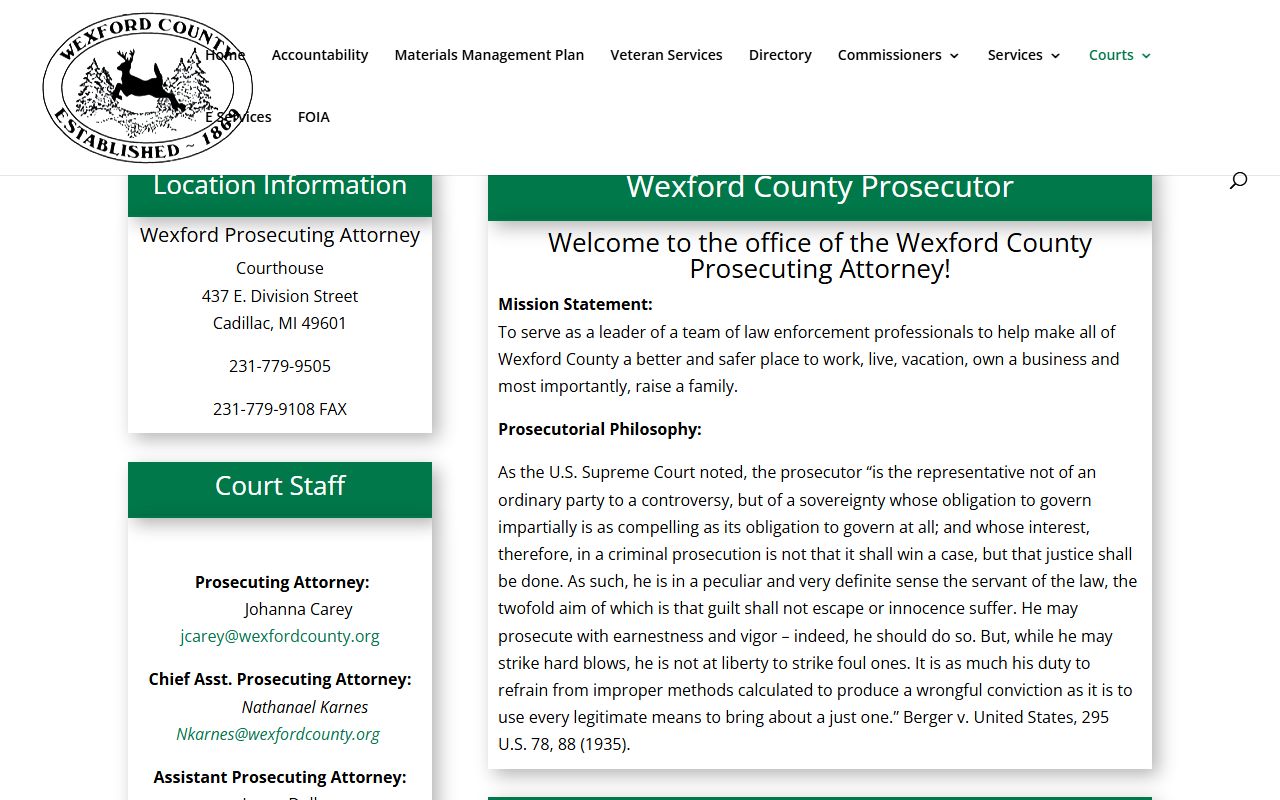
Because the prosecutor's charging choices set the case in motion, that office is the source of the charges listed in every Wexford County criminal court record.
437 E. Division Street, Cadillac, MI 49601
(231) 779-9505
On the other side, the public defender is assigned only after the court finds a defendant eligible. Eligibility is decided at arraignment based on the person's finances. If the defendant qualifies, the office appoints an attorney and contacts the person within 48 hours. The office opened in 2018 as one of the first of its kind in northern Michigan, and it does not take paid cases.
The Wexford Missaukee Public Defender office describes how appointed counsel is assigned to eligible defendants.
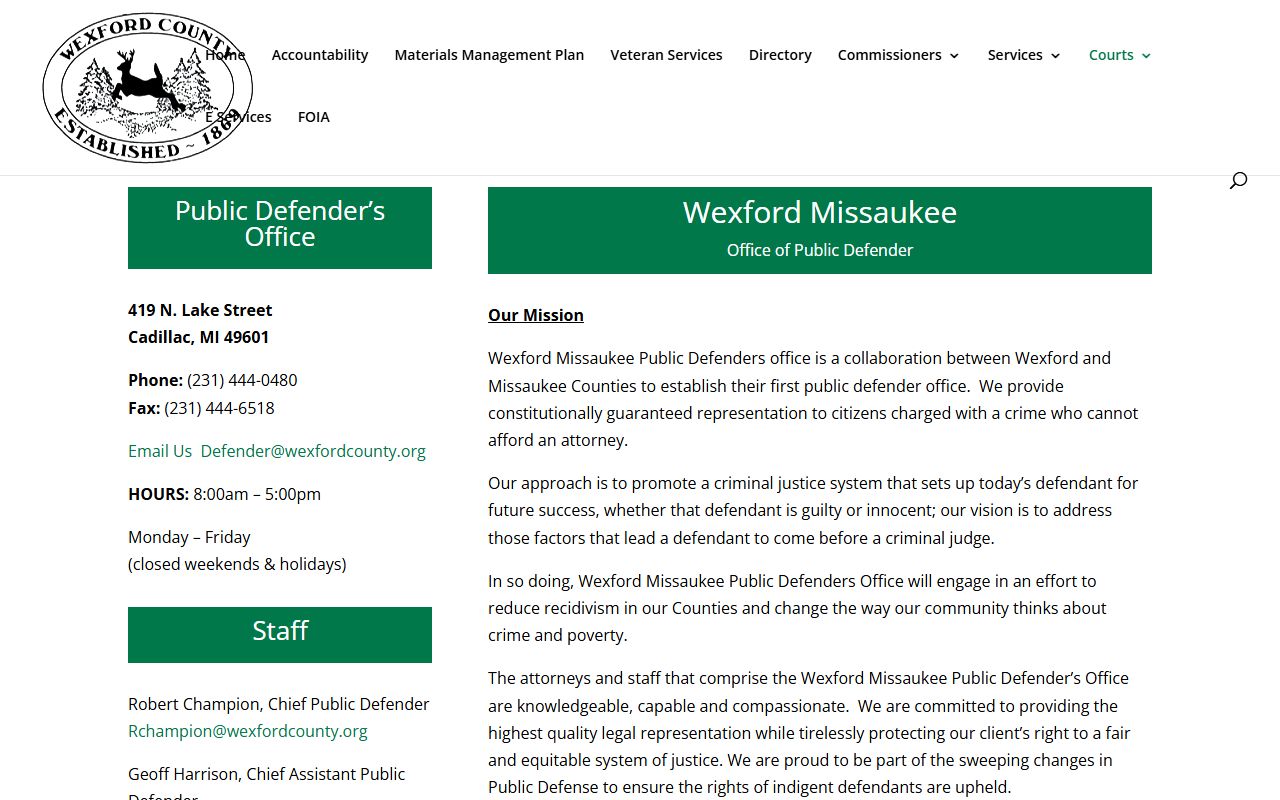
Whether a defendant is represented by appointed or private counsel shows up on the register of actions, so the defense attorney of record appears in the file.
419 N. Lake Street, Cadillac, MI 49601
(231) 444-0480
What a Wexford County Criminal Court Record Shows
A criminal court file is built from many small fields, and each one answers a different question about the case. Wexford docket samples show a court name, a case number, a case type code, party names, hearing codes, dates, and times. A full case file adds the fields a public docket does not always display, such as plea, disposition, and sentence. Reading the fields together turns a list of codes into a clear story of what happened.
| Field | What It Shows |
|---|---|
| Case Number | The unique court identifier, such as 21-3634-FY-1, with a type code that flags a felony, misdemeanor, or other case class. |
| Court | Whether the case sits in the 84th District Court or the 28th Circuit Court, which signals its stage and severity. |
| Defendant | The name of the person accused, along with the party role listed on the docket. |
| Charges | Each offense as filed, the statute or ordinance cited, and any later amendment or reduction. |
| Bond | The release conditions and any money or security set at arraignment to secure future appearances. |
| Plea | How the defendant answered the charge: guilty, not guilty, or no contest. |
| Disposition | The outcome of each charge, from dismissal or acquittal to a conviction by plea or verdict. |
| Sentence | The judgment of sentence, listing jail or prison time, probation, fines, costs, and restitution. |
Note: Public docket samples in Wexford County often show names, codes, and hearing times but not plea or sentence, so the full outcome may require the clerk's file.
Wexford County Charges Versus Convictions
Being charged is not the same as being convicted. A charge is an accusation, and it can be dropped, dismissed, reduced, or end in an acquittal. A conviction is the court's finding of guilt, entered after a plea or a verdict. A Wexford County criminal court record can show a defendant who was charged with a serious offense yet convicted of a lesser one, or not convicted at all. Reading the disposition line, not the charge line, tells you how the case actually ended.
| Charge | Conviction | |
|---|---|---|
| Stage | Accusation at or after filing | Finding of guilt by plea or verdict |
| Who Decides | The prosecutor | The judge or jury |
| Burden of Proof | Probable cause | Beyond a reasonable doubt |
| Can It Change | Yes, it can be amended, reduced, or dropped | Only through appeal or set aside |
| Public Record | Yes | Yes, unless later set aside |
Reading Dispositions and Sentences
The disposition is the current or final outcome of a charge, and the sentence is the punishment set once a conviction is entered. A file may show several dispositions when a case has more than one count. A charge can end in a guilty plea, a no contest plea, a guilty verdict, a dismissal, or an acquittal. When the disposition is a conviction, the judgment of sentence spells out what the defendant must do. In Wexford County the sentence often blends jail time, probation, and money owed rather than one single penalty.
Sentence terms in the record reward a close read. Jail time may be served in the county jail, while a felony prison term is served through the state. Probation puts a defendant under supervision with conditions, and restitution orders money paid back to a victim. Fines and costs are separate line items, and unpaid balances stay tied to the case. When you see a term you do not recognize, the short glossary below covers the words that appear most often.
- Disposition
- The final or current outcome of a charge or the whole case.
- No contest
- A plea where the defendant does not admit guilt but accepts conviction for sentencing.
- Restitution
- Money the court orders a defendant to pay to compensate a victim.
- Judgment of sentence
- The court order that fixes the penalty after a conviction.
- Bindover
- The transfer of a felony from District Court to Circuit Court after probable cause is found.
Sealed Versus Set Aside or Expunged Records
Michigan does not use the word expunge in its statute. The legal term is set aside. When a conviction is set aside, it becomes nonpublic for most background searches, though law enforcement and some authorized agencies can still see it. A sealed record is hidden by court order in a narrower set of situations. Neither one erases the case from the earth, but a set aside comes closest to the everyday idea of a clean record. Wexford County users should identify the exact case and conviction before starting either path.
| Sealed | Set Aside / Expunged | |
|---|---|---|
| Visibility | Hidden from public view by court order | Nonpublic for most background searches |
| Law Enforcement | Limited access remains | Police and some agencies can still access it |
| Michigan Term | Sealing, used in narrow situations | Set aside under state law |
| Eligibility | Depends on case type and court order | Only certain convictions qualify; some are excluded |
| How It Happens | By motion and court order | By application or automatically under Clean Slate |
An application to set aside a conviction is governed by state statute. The convicting court handles the filing, and the process usually calls for forms, fingerprints, service on required agencies, and often a hearing. The lead-in image opens the actual Michigan statute that lays out who may apply.
The Michigan Legislature publishes MCL 780.621, the conviction set-aside statute that defines eligibility.
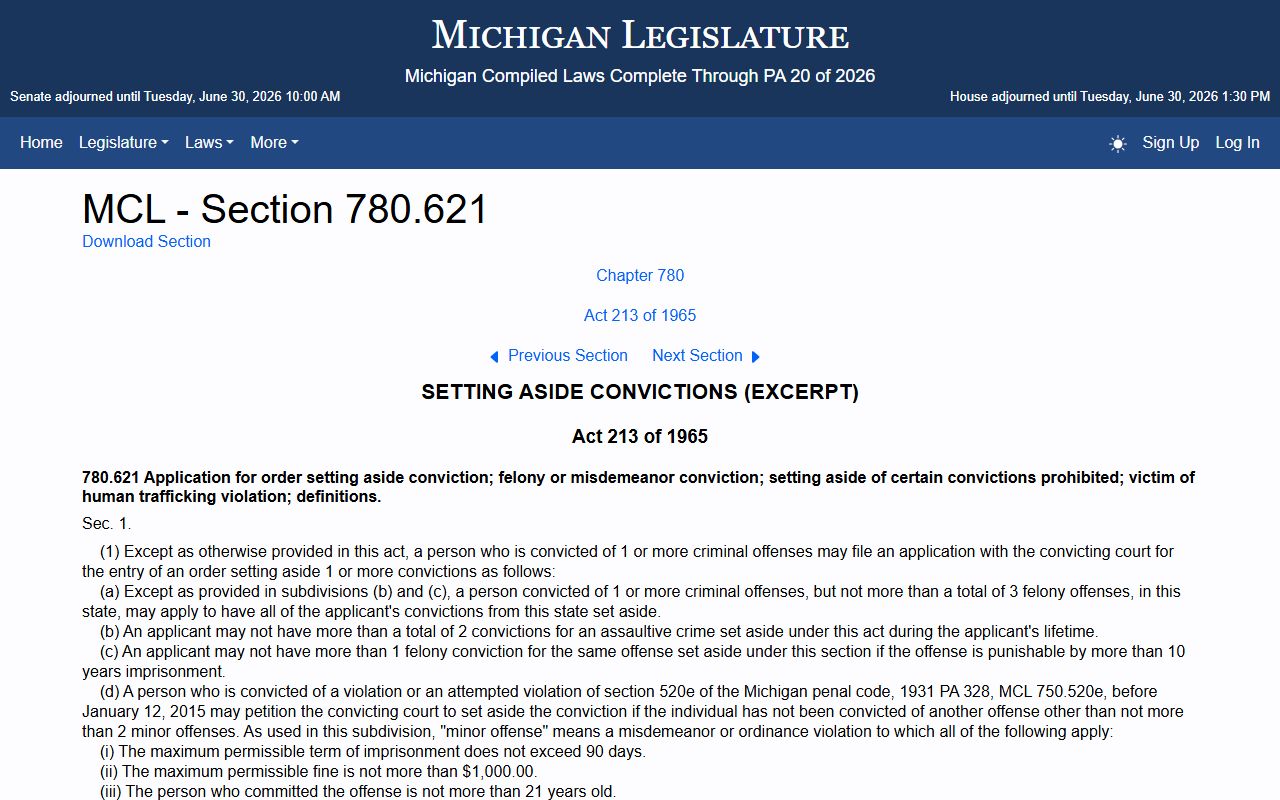
Because the statute limits which convictions qualify, checking eligibility early saves a Wexford County applicant from filing on a conviction that cannot be set aside.
Public Access to Wexford County Criminal Court Records
Criminal case files in Michigan are open by default. Court records follow the Michigan Court Rules rather than county policy, and those rules make most case files available for public inspection while allowing redaction of protected information. Separately, the Michigan Freedom of Information Act declares a public policy favoring access to government records, and it covers county administrative files. For a court case file, the clerk of the convicting court is the correct first stop; for county administrative records, the county's FOIA process applies with a five business day response window.
Key Statutes and Rules:
MCL 15.231 - Michigan's Freedom of Information Act states a public policy favoring access to records of government affairs and official acts, subject to exemptions.
MCR 8.119 - Court clerks maintain court records, and access to case files is governed by court rule rather than county FOIA alone.
MCL 780.621 - Eligible people may apply to set aside certain convictions, which then become nonpublic for most purposes.
Background Check Considerations
There is a real difference between a casual lookup and a formal background check. Reading a MiCOURT case file or running an ICHAT report answers a personal question about a case. A background check used to make a hiring, housing, or credit decision is regulated by the federal Fair Credit Reporting Act, and it must come from a licensed consumer reporting agency that follows strict accuracy and notice rules. A single county file may also miss convictions from other counties or states, so a statewide or nationwide check pulls from broader sources.
Important: This site is not a consumer reporting agency under the FCRA, and its information may not be used for employment, housing, credit, or other regulated screening.
Restricted Criminal Court Records in Wexford County
Not every criminal matter is open to the public. Juvenile delinquency cases run through the Circuit Court Family Division and are frequently nonpublic. Records that touch child neglect, abuse, or mental health treatment are restricted for privacy reasons. Wexford probate and family docket samples even label some entries as NON-PUBLIC, which is a clear signal that the file is closed. Convictions that have been set aside also drop out of public view, and personal identifying information can be redacted from otherwise open files.
Michigan's Clean Slate program adds another layer by setting aside some eligible convictions automatically after a waiting period, with no application needed. Certain misdemeanors punishable by 92 days or less can become nonpublic seven years after sentencing, held only in court case management systems. When a case was confidential from the start, the correct path is a court order or an eligible-party request rather than a public search.
The Michigan State Police Clean Slate page explains which convictions are set aside automatically and when.
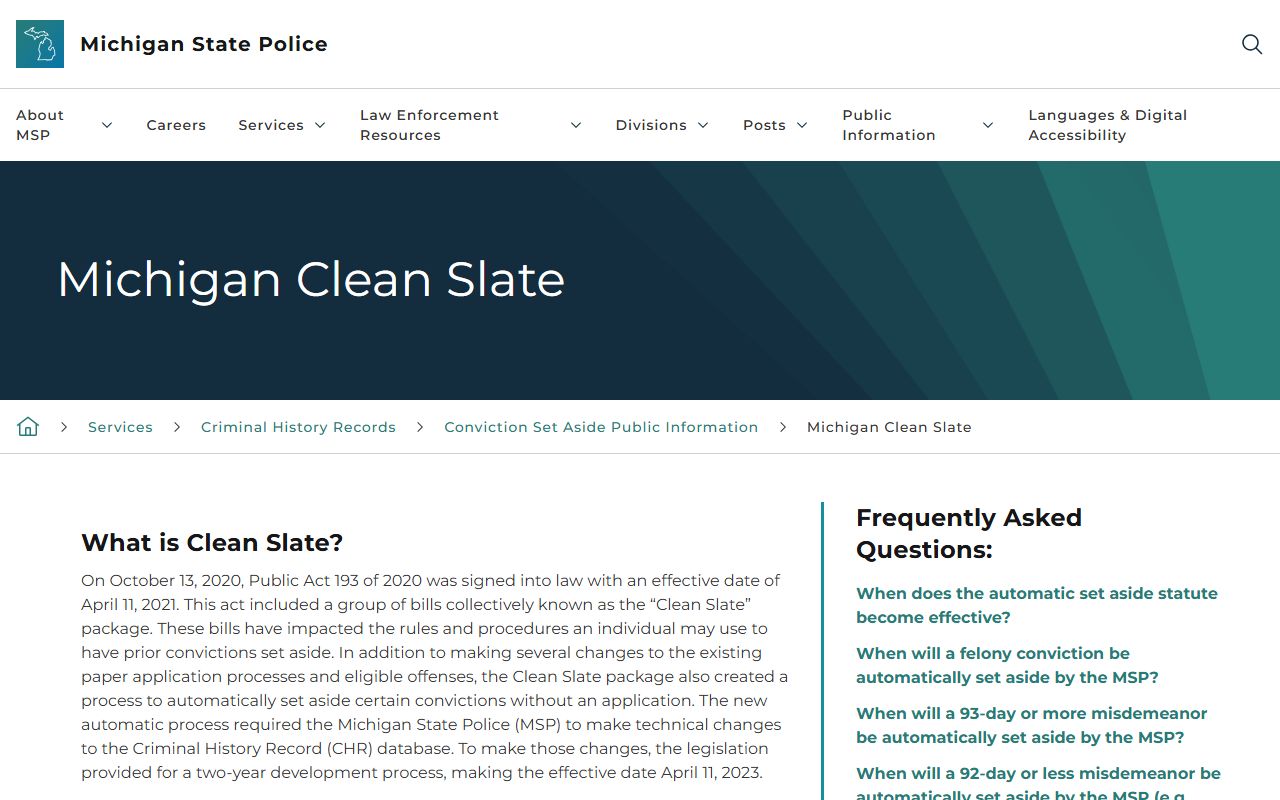
Once a conviction clears under Clean Slate, it stops appearing in a standard Wexford County criminal court records search, even though the case once was public.
Note: Whether a warrant is outstanding is a separate question that a criminal case file does not always answer, and active warrants are tracked apart from closed dispositions.